Apple Fiber Powder for Dairy and Plant-Based Alternatives
Apple fiber powder has quietly become one of the most versatile functional ingredients in modern food formulation. Derived from apple pomace — the solid residue left after juice pressing — this brownish-yellow powder delivers a balanced ratio of soluble and insoluble dietary fiber. For manufacturers developing dairy alternatives, plant-based milks, yogurt analogs, or protein shakes, apple fiber powder improves texture, stabilizes viscosity, and extends shelf life. Its clean-label appeal, combined with non-GMO, gluten-free, and vegan credentials, positions it as a strategic ingredient for forward-thinking B2B buyers across the U.S. food and nutraceutical sectors.
Understanding Apple Fiber Powder and Its Role in Dairy & Plant-Based Alternatives
Apple Fiber Powder has two types of fibers in one, one that is soluble and one that is structurally solid. This gives it two uses that few single-ingredient fibers can match. In plant-based yogurts and oat milk recipes, where it's hard to keep the right consistency without synthetic stabilizers, pectin is a great natural emulsifier and moisture binder. Studies have shown that taking extra pectin lowers LDL cholesterol levels and helps keep blood sugar levels in check. Besides health benefits, the fiber's ability to hold water makes low-fat dairy alternatives feel better in the mouth, which is a problem that product developers keep having to solve.
Apple-derived fiber mixes easily into drinks and fluid dairy formats, unlike psyllium husk, which forms thick gels that can make thin liquid structures less stable. Oat fiber works best when baked, but it's not very good at emulsifying. Inulin helps the bacteria in the gut, but it doesn't do much for the texture. Apple pomace fiber is a useful nutrient because it has prebiotic properties, controls wetness, and comes from a source that is safe for the environment.
Comparing Apple Fiber Powder to Alternative Fibers and Ingredients
When purchasing teams compare apple pomace powder to other options, the supplier with the highest certification status is often the one who moves on to the shortlist. Organic Apple Fiber Powder has approvals from the EU, the USDA, and EcoCert. These approvals directly support expensive SKU placement in health retail channels. While conventional fiber may provide similar technical performance, it makes it harder to get into the natural and clean-label markets, where stores are increasingly requiring organic paperwork.
The allergen profile is also important. Apple fiber is naturally gluten-free, non-allergenic, and compliant with vegan labeling standards. This is different from wheat bran and oat fiber, which can cause gluten-related issues. This makes regulatory friction a lot less, especially for businesses that sell to both the U.S. and EU markets at the same time. It is more cost-effective to use apple pomace fiber instead of inulin per kilogram because it has the same prebiotic effect and costs less. This makes it a good choice for high-volume supplement and beverage formulations.
Application Strategies: How to Use Apple Fiber Powder in Dairy and Plant-Based Alternatives
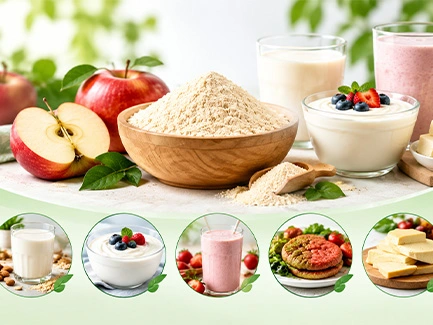
When adding Apple Fiber Powder to drinks and other liquid dairy alternatives, product developers usually work with a 2–5% inclusion rate. Higher concentrations (up to 8–10%) work well for semi-solid foods like plant-based yogurt, cheese substitutes that can be spread, and protein shake powders. The 98% specification, which has been checked by HPLC, UV, and GC tests, works well for nutraceutical capsules and tablets that need to be consistent. The 60% standard works well in food-grade settings where lowering costs is important along with good performance.
Here are the main uses for apple pomace fiber that can be measured in terms of their value:
- Plant-based milk and yogurt: Adding 2–4% of it lowers phase separation during keeping in the fridge and makes the product seem creamier without adding fat or gums. It doesn't have any off-tastes like some grain-based fibers do because its flavor is bland.
- Protein shakes and meal replacements: Apple dietary fiber, at 3–5%, makes the solution more stable during UHT processing and stops sedimentation in ready-to-drink forms. This is similar to the benefits seen with other fine-particle functional fibers when it comes to dispersibility.
- Cheese analogs and spreads: It keeps food fresh longer and lowers syneresis, the unpleasant split of liquids that makes plant-based cheeses less enjoyable for consumers.
Apple Fiber Powder has become popular in uses other than baking, as shown by these examples. One thing that should be thought about when making the formula is that people with sensitive digestive systems may feel mild bloating when they eat a lot of fiber. Labeling suggestions that are in line with FDA fiber guidelines—usually 3g per serving as a minimum for a "good source" claim—help set realistic goals and make sure that regulations are followed.
Procurement Guide: Sourcing Quality Apple Fiber Powder for Global B2B Clients
Apple Fiber Powder buyers choose a supplier based on three things: verified certifications, production ability, and uniformity from batch to batch. A trustworthy company that makes Apple Fiber Powder should have at least ISO22000, HACCP, and cGMP certifications. Fairir has all of these certifications: USDA Organic, HALAL, Kosher, FSSC22000, and BS EN 15662. These are all requirements for suppliers who want to sell to high-end markets in the U.S. and Europe.
Infrastructure for production is just as important as papers. Manufacturers with three fully automatic production lines and extraction efficiencies of up to 98%, as shown by HPLC, UV spectrophotometry, and rotary evaporator analysis, give buying teams the group stability they need to avoid expensive re-formulations. Geographic sourcing from well-known extraction hubs in Shaanxi Province, China, where apples are grown in large numbers and the origin of raw materials can be easily tracked, offers cost and quality benefits that Western buyers are becoming more aware of.
When buying in bulk, the goods are packed in vacuum aluminum foil bags or 25 kg fiber drums with two layers of food-grade poly bag covers. This keeps the goods dry while they're in transit. Deliveries within 1–3 business days, a flexible minimum order quantity, and the ability to get free samples all lower the risk of buying, especially for first-time buyers or R&D teams that are testing new formulations.
Future Trends and Strategic Considerations for Apple Fiber Powder in Food & Beverage Innovations
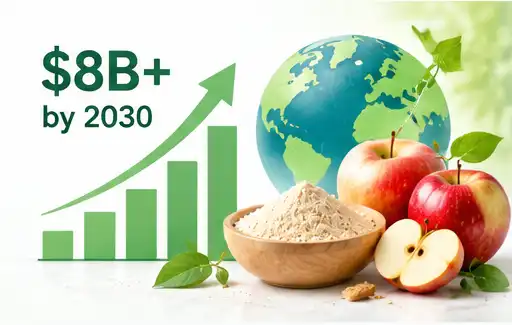
By 2030, the global market for dietary fiber is expected to be worth more than $8 billion. The fastest-growing demand segment is for plant-based foods. Changing rules are speeding up this growth. The FDA's new meaning of dietary fiber needs proof of physiological benefits, which apple-derived pectin fiber meets with proven data on lowering cholesterol and controlling blood sugar.
Improvements in extraction methods, such as ultrafine pulverization and cold-press pomace processing, are making apple pomace powder more useful by making grades that are easier to mix and have a more even molecular weight distribution. It means that buyers of ingredients will have more tools at their disposal. Working together early on with an Apple Fiber Powder source that is highly skilled and can build custom specifications puts brands ahead of rivals who are still buying cheap fibers.
Stories about consumer demand for "upcycled ingredients" also like apple pomace fiber. Since pulp is a result of making apple juice, its use is in line with the values of the circular economy, which appeal to buyers who care about the environment. This is an important difference that supports both marketing claims and ESG reporting.
Conclusion
Apple Fiber Powder is one of the most useful ingredients in current dairy and plant-based recipes. Because it has two types of fibers, is clean label, and can be used in many different ways, it is a very valuable ingredient for food companies, nutrition companies, and research and development teams. Consumers want more gut-healthy, eco-friendly ingredients, and regulations are rewarding fiber claims with more and more evidence. This means that getting a reliable, certified apple pomace fiber now is a smart move. A common ingredient can become a competitive formulation edge with the help of the right supply partner—one that offers approved manufacturing, rigorous analysis, and quick technical support.
FAQ
What specification of apple fiber powder suits beverage applications?
The 60% standard works well with most food and drink bases and provides cost-effective fiber addition that is easy to spread. The 98% grade, which has been checked by HPLC and UV tests, is the best choice for nutraceutical pills or capsules that need to be precisely standardized.
Is apple fiber powder compatible with vegan and allergen-free formulations?
Yes. Fiber from apple pomace is naturally gluten-free, non-GMO, vegan, and free of allergens. It is also BSE and TSE-free, which means it can be used in formulations for sensitive consumer groups.
How does apple dietary fiber compare to inulin for prebiotic applications?
Both inulin and apple pomace fiber help good bacteria in the gut, but apple pomace fiber also adds structural and textural benefits that inulin can't. Apple fiber can be used in more situations than just prebiotic ones because it can control solubility as well.
What certifications should I require from an apple fiber powder supplier?
Give at least ISO22000, HACCP, FSSC22000, cGMP, and USDA Organic the most weight. Getting HALAL and Kosher approvals will help you reach a lot more customers, especially in the Middle East and Jewish food markets.
Can I request a sample before placing a bulk order?
Yes. Reputable companies that make Apple Fiber Powder give away free samples so that you can try out the recipe before committing to full production amounts.
Partner with Fairir for Premium Apple Fiber Powder Supply
Fairir sells Apple Fiber Powder that is GMP-certified and also has ISO22000, USDA Organic, HALAL, Kosher, and FSSC22000 certifications. We are a reliable Apple Fiber Powder supplier for U.S. buyers because our 3 fully automatic production lines and 98% extraction efficiency make us a good choice. You can get free samples, private labeling, and specifications that are made just for you. To get your sample right away, email our team at sales@fairirbiotech.com.
References
1. Frontiers in Nutrition (2020). "Pectin supplementation and LDL cholesterol reduction: A meta-analysis."
2. U.S. Food and Drug Administration (2018). "Dietary Fiber: Definition and Guidance for Food Labeling."
3. Grand View Research (2023). "Dietary Fiber Market Size & Forecast, 2023–2030."
4. U.S. Food and Drug Administration (2020). "Scientific Review of Isolated and Synthetic Non-Digestible Carbohydrates."
5. Food Technology Magazine — Institute of Food Technologists (2022). "Upcycled Ingredients: Apple Pomace and the Circular Economy."
6. Journal of Food Science (2021). "Functional properties of apple pomace dietary fiber in plant-based dairy analog systems."