How Is Matcha Powder Used in Commercial Beverages?
Matcha Powder is one of the most desired functional ingredients in the production of commercial beverages. Made from shade-grown Camellia sinensis leaves and stone-ground to a super-fine powder, it offers a wonderfully balanced mix of natural caffeine, L-theanine, and EGCG antioxidants. Beverage companies infuse matcha powder into a range of RTD beverages including lattes, smoothies, energy formulae and even fizzy beverages. Its bright green color, savory depth, and verified health benefits make it an appealing ingredient for businesses targeting health-conscious customers. When procurement teams know where it’s being used, they can make wiser sourcing selections.
Understanding Matcha Powder and Its Role in Commercial Beverages
Unlike the other green tea products, Matcha Powder is prepared and consumed differently. Leaves are shaded for a period of 20 to 30 days before harvesting. It generates more L-theanine and chlorophyll. This directly alters the bioactive profile and the distinctive flavor of the powder. Because it is stone-milled at low temperatures, Matcha Powder holds volatile fragrance compounds that spray-dried or otherwise processed tea powders cannot duplicate.
Production Grades That Matter
The ceremonial grade Matcha Powder is greater in the ratio of amino acids to catechins . This takes the umami flavor and makes it milder, sweeter. It works excellent for high quality beverages that need to taste extremely clean. Culinary-grade matcha harvested later in the season is more astringent and has more catechin content, so it can cut through fat, sugar and cheese without losing its flavor. In a 2020 study published in the Journal of Food Science, researchers found that matcha used in cooking still has enough EGCG to offer the drinks you make with high antioxidant effect.
Nutritional Value That Influences Formulation Choices
Matcha Powder offers roughly 34 mg of caffeine and a healthy dose of EGCG (a catechin that helps the brain and metabolism perform better) for every 2 grams. Caffeine pills are just caffeine, however Matcha Powder includes that stimulant PLUS L-theanine, a compound that takes the edge off that powerful caffeine surge and helps you stay awake longer. And this is just what nutrition companies and energy drink manufacturers desire.
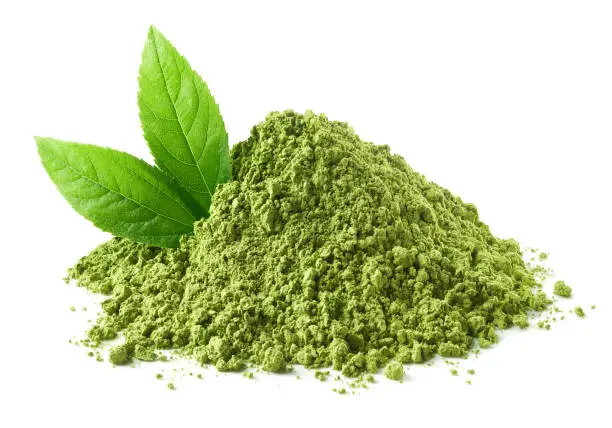
How Matcha Powder Is Used in Various Commercial Beverage Types
Matcha Powder works across many beverage formats, but each format puts different demands on the powder, and the processing step is the main constraint. The table lists the main beverage types and their key requirements.
|
Beverage type |
What the powder must do |
Main constraint |
|
Canned or bottled green tea (RTD) |
Stay suspended and keep colour through sterilisation; consistent particle size and low astringency |
Heat treatment degrades chlorophyll; needs a low-bioburden powder and a process designed for it |
|
Energy drinks |
Replace part of synthetic caffeine with a plant source in clean-label products; caffeine and L-theanine support a "calm energy" story |
Standardise caffeine by assay; keep claims to caffeine and theanine content |
|
Lattes, smoothies and creamy drinks |
Disperse in dairy or plant-based liquids; pre-mixing with a dry carrier such as maltodextrin helps |
Water absorption causes clumping; use high-shear inline mixing |
|
Sparkling and clear drinks |
Stable dispersion in acidic or carbonated bases |
Low pH and light drive chlorophyll browning; needs buffering and UV-blocking packaging |
Processing Constraints and Colour Protection
Standard UHT treatment (around 135°C to 145°C for a few seconds) is hard on chlorophyll, because heat and acidity remove the central magnesium and convert chlorophyll to brownish pheophytin, so a conventional matcha run through a conventional UHT line commonly turns olive or brown. Colour in RTD matcha can be kept only by combining a low-bioburden, beverage-grade powder with a thermal process designed for the formulation, and published work reports that pasteurisation lowers levels of analytes and worsens colour and turbidity parameters. The table summarises the constraints.
|
Process step |
Effect on matcha |
Visible result |
Protection strategy |
|
UHT (about 135-145°C) |
Chlorophyll converts to pheophytin; catechin loss and epimerisation |
Olive to brown colour, cooked or astringent notes |
Use low-TPC beverage-grade matcha with a formulation-specific thermal curve; do not assume a standard cycle is safe |
|
Pasteurisation (lower temperature) |
Still lowers analyte levels and worsens colour and turbidity |
Duller colour, more haze |
Minimise heat load; prefer powder pre-treated to reduce bioburden |
|
Low pH |
Faster chlorophyll breakdown below roughly pH 6 |
Olive-brown shift |
Buffer toward the near-neutral range, but test flavour and catechin stability |
|
High pH |
Accelerates catechin oxidation and non-enzymatic browning |
Darkening, flavour change |
Avoid alkaline bases |
|
Light and oxygen |
Chlorophyll photosensitises oxygen; lipids oxidise |
Fading, off-flavour |
Opaque packaging, nitrogen flushing, cold storage |
These uses show why all kinds of drink companies look for sources of matcha green tea powder that can guarantee batch consistency, provide technical documentation and give grade-specific specifications.
Selecting the Right Matcha Powder for Commercial Beverage Production
A business that wants to buy a lot of Matcha Powder looks at more than just the price per kilogram. There are real quality factors that can be tested that affect how well something is made.
Key Selection Criteria for B2B Buyers
The most clear sign of quality is colour. High-quality Matcha Powder has a bright, rich green colour because it has a lot of chlorophyll a and b. Tones that are turning yellow or dull are a sign of rust or a bad time to gather. Texture roughness, which is generally measured at 400 mesh or less, changes how liquids spread out.
It's no longer enough for many U.S. imports to be organic; they have to be in order to stay in business. People who want to sell their goods in stores or abroad should make sure they have ICP-MS heavy metal testing proof and a USDA Organic certification or something similar. You are less likely to buy something if you can find out where it came from. This supports claims of product-level openness.
Matching Grade to Application Efficiently
It costs more money and makes the result less good when the grade isn't right for the job. Adding traditional Matcha Powder to a mix for high-sugar bubble tea makes it cost more without making it taste better. But putting cheap cooking powder in a fancy cold brew matcha latte is bad for the brand's reputation. Procurement teams are more likely to buy from sellers who offer analysis papers along with grade ideas that are specific to the application.
Procurement Strategies for Matcha Powder in Bulk and Industrial Volumes
To get a lot of Matcha Powder, you need a clean way to compare sellers, plan quantities, and handle shipping. The U.S. market for importing green tea ingredients has steadily grown. Every year, more herbal extracts are brought in because more people are interested in health products made from plants.
A standard Certificate of Analysis (COA) comes with every batch that you buy from a reputable seller. It shows how much EGCG, moisture, heavy metals, microbes, and pesticide residues are present (measured by HPLC). If a production area is GMP-certified, it means that the process is being done right, which means that each run will be the same. Companies that make drinks and have constant production lines need to do this.
It's also important to plan for how to store and move things. To prevent the lipids from oxidising and the moisture from absorbing, Matcha Powder must be packed in multilayer aluminium foil that has been flushed with nitrogen and handled cold (below 15°C). Make sure that your service uses Peroxide Value (PV) tests to keep an eye on rusting over the product's shelf life. This is another step in your quality assurance process.
Key Challenges and Best Practices When Using Matcha Powder in Commercial Beverages
Even expert drink formulators run into problems when they try to make Matcha Powder into a business product. Being able to control solubility, keep colours true, and make sure that regulatory signs are right are the most common ones.
Chlorophyll stability goes down when the pH of a drink drops below 6.0 or when goods are left out in the light for a long time. This is taken care of by buffering agents and packing that blocks UV light. Matcha Powder can be more easily dissolved if it has been pre-hydrated in a small amount of warm water before being added to the rest of the mixture. This also keeps the powder from sticking together when a lot of it is mixed at once. The colour stays stable with a small amount of ascorbic acid, and it doesn't add any bad tastes.
When Matcha Powder is advertized as a useful ingredient, the FDA (U.S. Food and Drug Administration) wants the right amount of caffeine to be written on the label. For claims to be organic, there must be proof from a third party that can be traced back to the batch level. Many brands have a lot more trouble meeting these requirements than brands that rely on informal supplier relationships. This is because informal supplier relationships are not as good for technology.
Conclusion
Matcha powder is not only a fashionable ingredient; rather, it is a sophisticated and valuable element that must be located and produced with particular attention to detail. The stringent processing procedure, the high-quality ingredients, and the dependable supply chain that backs it up are the factors that contribute to its value. It may be utilized in the production of ready-to-drink beverages as well as nutrition mixtures. It is always better for business for buyers to select Matcha Powder with the same care and attention to detail that they use when selecting other standard plant items. Matcha Powder is a delicious alternative to other plant products.COAs that are batch-specific can be obtained from merchants who you can rely on. High-performance liquid chromatography (HPLC) was used to determine the levels of EGCG, moisture, heavy metals (as determined by ICP-MS), microorganisms, and pesticide residues. When a factory has GMP certification and automated production lines, there is a significant reduction in the amount of batch variation.

FAQ
Q1: How much caffeine does matcha powder typically contribute to a commercial beverage?
Matcha powder contains around 34 milligrams of caffeine for every two-gram intake. One serving of most ready-to-drink (RTD) beverages sold in stores contains between 1 and 4 grams of caffeine, which is equivalent to 17 to 68 milligrams of caffeine. This is a significant amount lower than the suggestion that the FDA has for frequent drinking.
Q2: What is the technical difference between ceremonial and culinary matcha powder?
According to the results of an HPLC analysis, ceremonial-grade Matcha Powder comes from harvests that take place in the first spring and has a greater ratio of catechins to amino acids. Because of this, the umami sweetness is enhanced even further. In the culinary world, matcha is often derived from later harvests, which include a greater quantity of catechins. This product is designed to maintain its flavor even after sweets and fats have been added to it.
Q3: How should matcha powder be stored to maintain stability?
Matcha powder should be stored in metal foil that has been flushed with nitrogen, away from light and air, and at a temperature that is lower than 15 degrees Celsius. There is a usual shelf life of twelve to eighteen months, and PV tests examine for lipid oxidation throughout this time.
Partner With Fairir for Reliable Matcha Powder Supply
Fairir sells premium Matcha Powder that has been fully analysed, is made in a GMP-certified facility, and meets HPLC standards so it can be used in drinks and vitamins. There are three fully automatic production lines in our plant that can get up to 98% of the stuff out. This makes sure that your production schedule is based on batches that are all the same. You can get samples or talk to our expert team about your needs for a bulk Matcha Powder supplier by emailing sales@fairirbiotech.com.
References
1. Kochman, J., Jakubczyk, K., Antoniewicz, J., Mruk, H., & Janda, K. (2021). Health Benefits and Chemical Composition of Matcha Green Tea: A Review. Molecules, 26(1), 85.
2. Grand View Research. (2023). Functional Beverages Market Size, Share & Trends Analysis Report.
3. USDA Foreign Agricultural Service. (2023). Tea: World Markets and Trade.
4. Weiss, D. J., & Anderton, C. R. (2003). Determination of catechins in matcha green tea by micellar electrokinetic chromatography. Journal of Chromatography A, 1011(1–2), 173–180.
5. Jakubczyk, K., Kochman, J., Kwiatkowska, A., Kałduńska, J., Dec, K., Kawczuga, D., & Janda, K. (2020). Antioxidant Properties and Nutritional Composition of Matcha Green Tea. Foods, 9(4), 483.
6. European Food Safety Authority (EFSA). (2015). Scientific Opinion on the Safety of Green Tea Catechins. EFSA Journal, 13(7), 4191.