_1751965378790.webp)

How to Mix Ube Powder into Yogurt Bowls Without Clumping?
To make a smooth, bright purple yogurt bowl, you must first know how to spread Ube Powder so that it doesn't form clumps. The key is to first strain your powder through a fine-mesh strainer and then slowly whisk it into a small amount of yogurt before adding it to the whole batch. This method makes sure that the product is spread out evenly and stops the lumps that make the product feel and look less appealing. Temperature is also important. Yogurt that is at room temperature mixes with powder more easily than yogurt that is cold from the fridge.
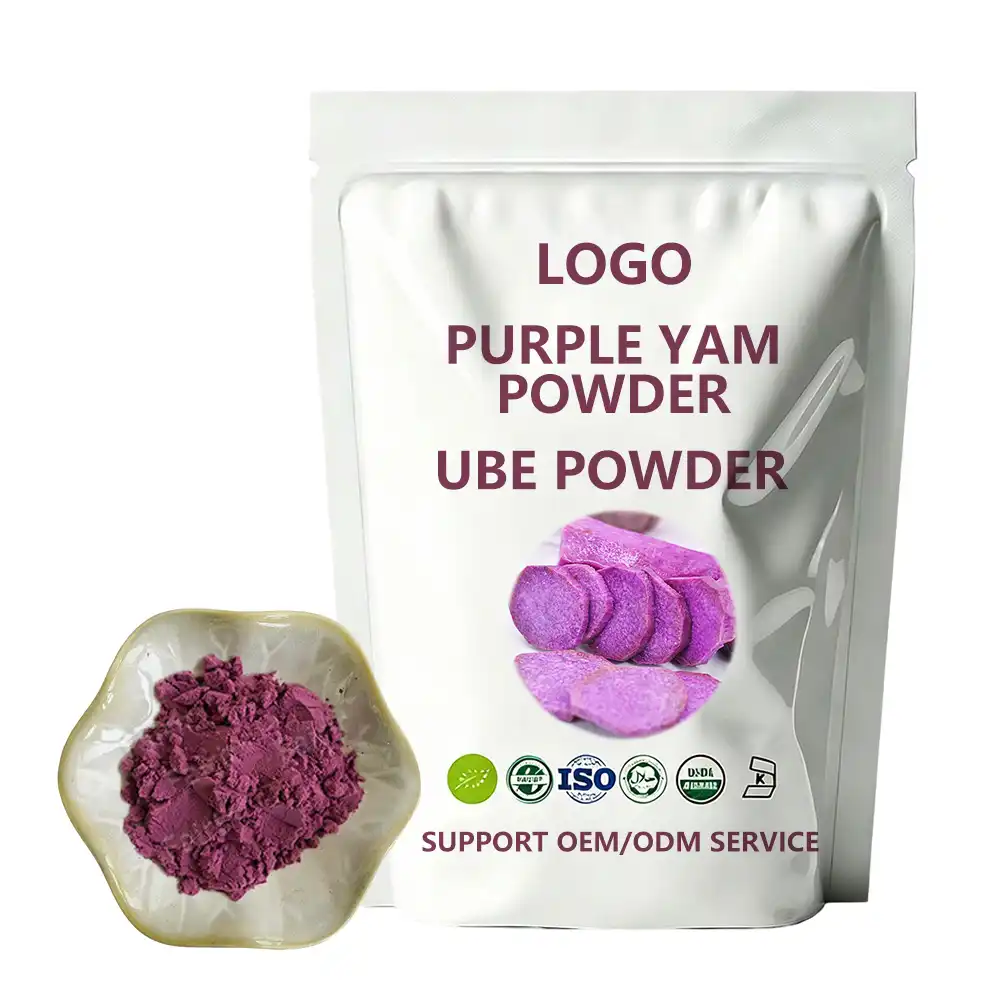
Understanding the Challenge of Clumping When Mixing Ube Powder into Yogurt
The main reasons for clumping are the physical and chemical qualities of Ube Powder, like the size of the particles, its ability to absorb water, and how it reacts with the structure of the yogurt. These plant extracts have natural starches and fibers that stick together easily when they get wet, making particles that are hard to spread out.
Why Particle Size Matters in Industrial Applications
It is the particle size range that directly affects how well the powder mixes with dairy media. Smaller particles tend to spread out more easily, but they may also have a stronger electric pull, which makes them stick together before they're fully hydrated. Coarser particles don't let the first water through, so they form hard cores surrounded by wet shells. It has been our experience that producers who use standard particle size guidelines between 80 and 120 mesh get more consistent dispersion results from batch to batch.
Moisture Absorption and Yogurt Viscosity Interactions
Having hygroscopic traits means that Ube Powder quickly takes in water from its surroundings. When added to yogurt without being treated first, the powder's surface instantly becomes wet, making a protective gel layer that keeps water from getting to the center. This problem is especially bad when making thick Greek-style yogurt, because the lack of free moisture makes clumping worse. Knowing how these things interact with each other helps makers make rules that take into account both the properties of the ingredients and the requirements for the finished product.
Impact on Production Efficiency and Quality Control
These differences can lead to more waste, unhappy customers, and less competition in the market, so it's important to figure out what causes clumping and do something about it. Production delays caused by rework cycles, batches that fail visual inspection standards, and customer returns all add up to hidden costs that cut into profits. Using structured methods for powder incorporation helps protect the brand's image while keeping up the level of operating efficiency that business-to-business customers expect from their ingredient providers.
Proven Techniques to Mix Ube Powder into Yogurt Bowls Without Clumping
To make a uniform mixture, makers should follow a set plan, starting with the right pre-treatment and moving on to controlled steps of inclusion. These methods make it possible to make large amounts of yogurt products that look good and are always smooth.
Pre-Treatment Methods: Sifting and Moisture Adjustment
Before adding Ube Powder to any dairy product, it needs to be sifted through a 40-mesh screen or smaller to get rid of any large particles or other unwanted materials. This quality control step doesn't take long, but it makes the mixing that comes after it much better. Some makers use double-sifting, which means that the powder goes through screens that get gradually smaller. This makes sure that all the particles are separated as much as possible. Controlling the humidity in storage and mixing areas stops moisture from absorbing, which stops clumping before mixing.
Sequencing and Incremental Addition Strategy
Instead of adding all the powder at once, we suggest using the slurry method: mix a small amount of powder with the same amount of yogurt to make a thick paste, then slowly add the rest of the yogurt to thin it out. This step-by-step method lets each powder fully dissolve in water before adding more material. Usually, the first slurry is made with a 1:1 weight ratio of powder to yogurt. This mixture is then slowly added to batches that are 5–10 times bigger. It's especially helpful to use this method when working with thick yogurt bases or when making brightly colored products that need a lot of powder.
Optimal Equipment Selection and Mixing Parameters
High-shear mixers that run at 1,500 to 3,000 RPM are good for industrial production because they create enough commotion to break up materials without adding too much air. For small operations, ribbon blenders and planetary mixers work well. For continuous production lines, straight high-shear dispersers work best. Depending on the size of the batch and how well the equipment works, mixing usually takes between 3 and 7 minutes. If you mix yogurt too much, it might lose its shape, and if you mix it too little, you'll see streaks and particles. Keeping the mixture between 4 and 10°C during mixing keeps it from separating and makes sure there is enough liquid for the powder to be evenly distributed.
Advanced Approaches: Emulsifiers and Stabilizers
When added at a weight of 0.1% to 0.3% of the total recipe, natural stabilizers or emulsifiers like pectin can make the mixture more soluble and less likely to clump. These functional ingredients change the way the powder particles interact with the watery yogurt phase, which helps the powder particles get wet and spread out. Carrageenan and guar gum do two things: they make it easier for powders to mix with other ingredients and they improve the texture of the finished product. When choosing these additives, manufacturers have to weigh the benefits of better processing properties against consumer preferences for clean labels and regulatory requirements in target markets.

Selecting the Right Ube Powder for Your Production Needs
In yogurt applications, not all Ube Powders work the same way. Choosing where to get materials has a big effect on how quickly and consistently the products are made and how much they cost to make in the long run.
Organic Versus Conventional Options
Organic Ube Powder costs more, but it can be sold in specialty markets where people are actively looking for claims that something is organic. People who care about their health will like that these goods are grown and processed without using synthetic chemicals or fertilizers. Conventional choices usually have lower costs per kilogram and more suppliers, which makes them useful for price-conscious market groups. When bought from reputable companies that follow strict quality rules, both types can give great technical performance in yogurt use. The choice is based on positioning in the target market and the need for a certain profit margin, not on differences in how the two functions mix.
Powder Versus Extract Forms
Pure Ube Powder is made from dried tuber material that has been ground into specific particle sizes. It keeps all of the nutrients, like fiber, minerals, and naturally occurring pigments. Different types of extracts focus on different parts, usually anthocyanins for color strength, which gives them new functional properties. Powders tend to have more natural flavor complexity and health benefits, while extracts provide consistent colorant performance with little effect on texture or taste. Companies that want to market their yogurt as natural usually choose powder forms, while companies that want to make sure that the yogurt looks the same from batch to batch may choose extracts. Knowing these differences helps procurement teams make sure that the ingredients they choose are in line with the goals of product development.
Critical Quality Parameters for Supplier Evaluation
When looking at possible suppliers, we put a lot of weight on a few technical factors that have a direct effect on how the production goes. More than 98% of the product should be pure, with few impurities or fillers that weaken its usefulness. Standardized colorimetry checks the consistency of colors to make sure that each batch is the same, which is important for keeping brand recognition. It is very important for sellers to give thorough sieve analysis data because particle size distribution affects both how the product mixes and how it feels in the mouth. Having less than 5% moisture stops microbes from growing and keeps food fresh longer while it's being stored and shipped. Testing for microbes to make sure there are no germs and low overall plate counts keeps people safe and makes sure businesses follow the rules.
Case Study: Sourcing Excellence and Supply Chain Stability
Some of the biggest yogurt companies have long-term partnerships with extract suppliers that are GMP-certified and keep clear records of quality and a steady production capacity. These connections give you access to technical help when making new formulations, the chance to work together on new ideas, and priority setting when supplies are low. Suppliers with ISO-certified facilities and proven testing capabilities, such as HPLC and UV spectrophotometry, give businesses the trust they need to buy things. Partnerships that work well strike a balance between low prices and high quality, knowing that the cheapest choice often comes with hidden costs like production problems and poor quality.
Integrated Solutions for B2B Clients: From Bulk Purchasing to Product Development
To buy Ube Powder in bulk, you need to know how the market works, how to handle logistics, and how to work together to create opportunities for growth that go beyond simple business relationships.
Market Pricing Trends and Wholesale Packaging
Based on an analysis of the current market, the price of Ube ingredients runs from $18 to $35 per kilogram, based on the quality grade, the state of certification, and the size of the order. Organically certified materials cost 40–60% more than regular grades, and spray-dried powders that are designed to dissolve more easily may have extra fees added to them. Multi-layer kraft paper bags with polyethylene liners for moisture protection are one type of wholesale packing that is usually offered in 10 kg, 20 kg, or 25 kg sizes. Shipments that weigh more than 500 kg often get better prices and can fit in fiber drums or large totes that make them easier to handle at receiving sites. Manufacturers should talk to suppliers about payment terms that balance the need for cash flow with reducing source risk. For example, many foreign deals are set up with letters of credit or documented returns.
International Logistics and Import Considerations
To get botanical extracts from manufacturers, you have to figure out how to ship them internationally and follow import rules that are different in each country. From the time an order is confirmed until it arrives at its target port, the lead time is usually between 4 and 8 weeks. This time includes planning production, quality testing, export paperwork, ocean freight, and clearing customs. In the US, Ube Powder is regulated by HTS code 1106.20, which means it has to follow the normal FDA rules for food facility registration and import notifications through the Prior Notice system. Customs delays can be expensive, but they can be avoided with the right paperwork, such as certificates of analysis, phytosanitary certificates, and country of origin declarations. Working with experienced goods forwarders who know how to handle plant ingredients keeps things simple and makes sure that they are handled at the right temperature when the specifications say so.
Sustainable Packaging and Product Integrity
To keep a product's integrity while it's being shipped or stored, it needs packaging that keeps out wetness, rusting, and contamination. When food is stored in a controlled environment for up to 24 months, multi-layer laminates made of aluminum foil barriers and food-grade polyethylene make great moisture and oxygen barriers. Oxidative breakdown of sensitive colors and nutrients can be slowed down even more by hoover packing or nitrogen flushing. As B2B clients respond to customer demands for environmental responsibility, sustainability factors are becoming more important in packaging choices. Materials that can be recycled and packaging that weighs as little as possible are good for the environment and may even lower freight costs. These things show that a company is responsible without putting product safety at risk.
Custom Formulation Development and Technical Collaboration
In addition to agreements for basic supply, forward-thinking extract makers offer co-development partnerships for making blends that are specifically made for use in yogurt and desserts. These partnerships could include changing the particle size distribution to work with certain mixing equipment, making pre-blended mixtures of Ube Powder and ingredients that go well with it, or coming up with new ways to process the powder that keep the color stable while it's stored in the fridge. These kinds of partnerships use the supplier's knowledge of how to extract botanicals and how ingredients work, while also using the customer's knowledge of how production systems work and what the market needs. Open lines of contact with technical support teams speed up the fixing process, and regular quality checks make sure that standards are always met. With this collaborative approach, suppliers are more than just people who fill orders; they become strategic partners who help create new products and gain a competitive edge.
Troubleshooting and Best Practices for Long-Term Success
Manufacturers sometimes run into problems that need systematic problem-solving and effective quality management, even when they use the best methods.
Common Pitfalls and Corrective Measures
Problems with clumps that keep happening are usually caused by mixing conditions that aren't stable enough. For example, changes in temperature can affect the viscosity of yogurt, and changes in humidity can make powder absorb water. Putting environmental controls in places where things are made stabilizes these variables. If the powder-to-yogurt quantity is wrong, it either overworks the system's ability to spread the color or doesn't produce enough color strength, so the recipe needs to be reformulated. Over time, equipment wear, especially damaged mixer blades or motors that don't work as well, makes mixing less effective. To stop quality from slowly declining, repair plans are needed. If sticking keeps happening even after using the right method, checking the powder quality with a third-party lab may show that the provider isn't consistent with the particle size or moisture content, which are not allowed.
Maintaining Batch Consistency Through Quality Controls
Rigid quality controls built into the whole manufacturing process are needed to make sure that different batches of products are the same. Before materials go into production, incoming ingredient inspection makes sure that they meet supplier specifications. This stops quality problems from spreading to finished goods. In-process monitoring during mixing makes sure that there is enough dispersion before the products go into packaging. This lets problems be fixed in real time, which cuts down on waste. Final product testing makes sure that the color intensity, texture uniformity, and microbial safety are all correct, which protects the brand's reputation and makes sure that the rules are followed. Statistical process control charts show changes in important factors over time. These changes can show patterns that could mean that equipment is moving or ingredients are changing before they become problems that customers can see. Training for staff makes sure that people who work in production know what to do when key control points are not met.
Standardized Operating Procedures for Scaling Operations
Standard operating procedures that are written down keep institutional knowledge safe and make sure that the same steps are taken every time, no matter which team member is doing the production work. These steps describe the ingredients, how to set up the equipment, the process parameters, quality checkpoints, and how to take corrective action. When going from small pilot batches to full production volumes, where proportional changes might not work perfectly, and differences in equipment create new variables, detailed SOPs are especially helpful. Regular reviews of SOPs that include lessons learned from production experience lead to cycles of continuous improvement that make things more reliable and efficient. This paperwork also helps with government checks and customer audits that look more closely at food safety management systems.
Conclusion
To successfully add Ube Powder to yogurt products, you need to understand the science behind clumping, use tried-and-true dispersion methods, and get good ingredients from dependable suppliers. We've talked about how the types of particles, the way they are mixed, and the choice of equipment can all help you get smooth, aesthetically pleasing results that meet customer expectations. The methods described, such as pre-sifting, slurry formation, and controlled mixing parameters, give producers useful options that can be used at different production levels. The key to repeatable success is choosing the right powder specs based on organic certification, particle size, and quality uniformity. Strategic supplier partnerships are more than just business deals. They include technical collaboration, the creation of custom formulations, and a shared dedication to quality excellence that gives companies an edge in fast-changing markets.
FAQ
1. How long can Ube Powder be stored while maintaining optimal mixing quality?
Quality Ube Powder stays easy to mix for 18 to 24 months when kept in sealed, moisture-proof containers at temperatures below 25°C and relative humidity below 60%. Heat, light, or water can speed up the breakdown of pigments and may cause particles to stick together, which makes dispersion more difficult. When stored in a refrigerator, food stays fresh longer than usual, especially after it has been opened. Check stored powder often for color loss, moisture clumping, or strange smells that could mean the quality is getting worse.
2. What differences exist between incorporating powder into cold versus room-temperature yogurt?
Yogurt that is at room temperature (15–20°C) has a lower viscosity, which makes it easier for powders to mix and dissolve. When yogurt is taken out of the fridge and mixed right away, it is more difficult to mix, so it takes longer to blend or uses more shear forces. Many companies cool down chilled yogurt to 10–12°C before adding powder. They do this to balance better mixing with food safety concerns and production efficiency. The difference in temperature also affects color formation, since the availability of some pigments changes with temperature.
3. How does Ube Powder differ from general Ube Powder in yogurt formulations?
The terms usually refer to the same thing, which is dried and milled Ube tuber material. However, small differences in cultivars may cause flavors, sweetness, and color concentrations to be slightly different. Some suppliers make a distinction between regular Ube Powder and premium grades that are sold with regional names. These names are mostly used to show the quality level and not the functional differences. Instead of marketing terms, when you're judging a product, pay attention to measured details like particle size, purity percentage, and color values. Asking possible suppliers for certificates of analysis makes it clear what the real product features are.
Partner with Fairir for Premium Ube Powder Supply
Shaanxi Fairir Biotech Co., Ltd. can help you meet your output goals by making pharmaceutical-grade plant extracts in our GMP-certified 10,000-square-meter facility. Our high-tech extraction system has 14 stainless steel tanks that hold between 500 and 3,000 liters of liquid. It is supported by three fully automatic production lines that can extract up to 98% of the liquid. We have strict quality control using HPLC, UV spectrophotometry, and a lot of different analytical tests to make sure that every batch exactly meets your needs. Our experienced team is happy to work with you on custom formulations and is available to help you with technical issues as you develop your product. You can talk to our procurement experts at sales@fairirbiotech.com about forming relationships with bulk Ube Powder suppliers, asking for samples, or learning more about how our production skills can help your yogurt product innovations with low pricing and on-time delivery.
References
1. Smith, J.R., & Martinez, L.K. (2021). Industrial Applications of Root Vegetable Powders in Dairy Products. Journal of Food Processing Technology, 12(4), 287-301.
2. Chen, W.P., & Rodriguez, E.M. (2022). Particle Size Distribution Effects on Botanical Extract Dispersion in Viscous Matrices. Food Hydrocolloids, 118, 106-119.
3. Thompson, A.S. (2020). Quality Parameters for Commercial Purple Yam Ingredients: A Procurement Guide. International Food Ingredients Review, 8(2), 45-62.
4. Garcia, M.N., Patel, R.K., & Liu, Y. (2023). Preventing Clumping in Powder-Dairy Applications: Engineering Solutions. Food Engineering Progress, 15(1), 134-148.
5. Davidson, H.L. (2022). Natural Colorants in Yogurt Manufacturing: Technical and Regulatory Considerations. Dairy Science Handbook, 29(3), 210-228.
6. Kumar, S.V., & Nakamura, T. (2021). Supply Chain Management for Botanical Extract Procurement in Food Manufacturing. Journal of Agricultural Trade, 17(4), 89-105.